Döhmann Audio Helix One MK3 Vacuum Turntable
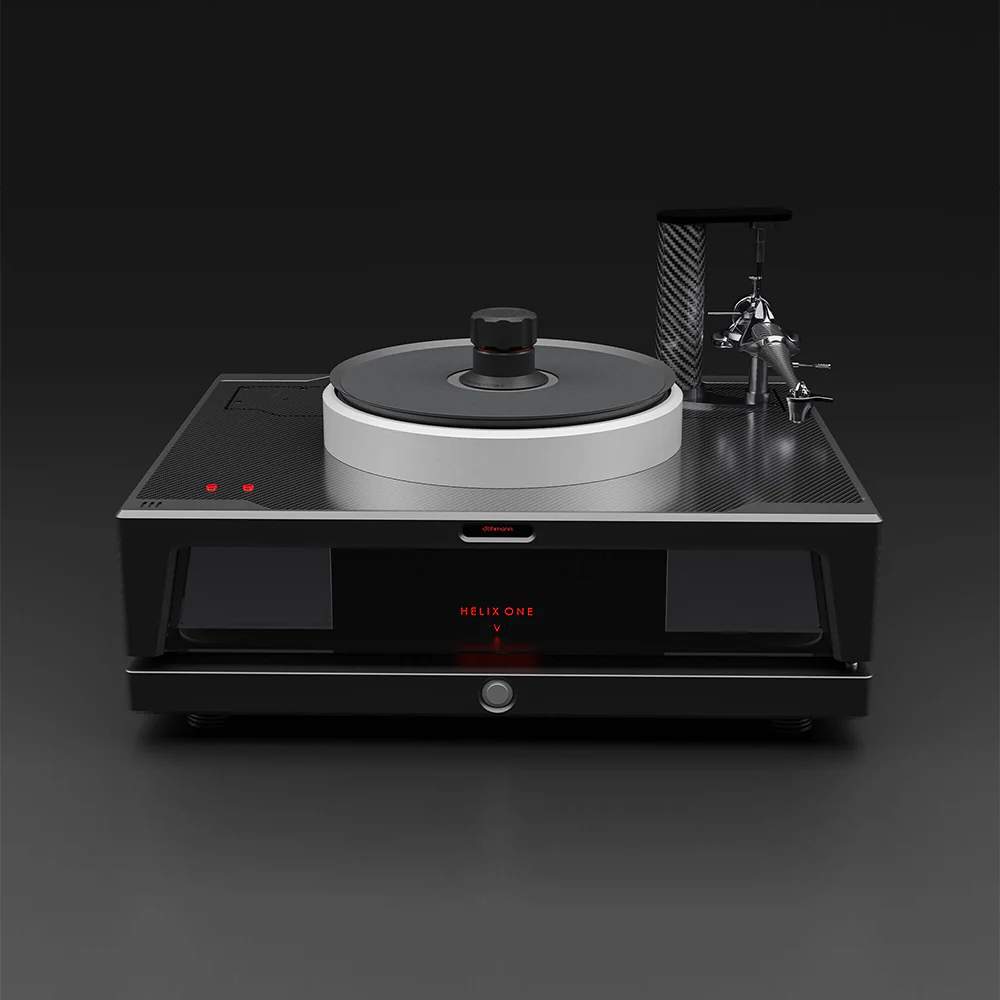
The Döhmann Audio Helix One Mk3 Vacuum turntable uses advanced isolation and precision engineering to eliminate vibration and reveal extraordinary detail from your records. With its vacuum hold-down system and ultra-precise motor control, it delivers unmatched realism and stability in vinyl playback.
OVERVIEW
The Helix One Mk3 has earned a reputation as an absolute reference turntable, despite not offering a vacuum system and has been frequently compared favorably in reviews to other turntables at the same pricing level which feature vacuum. For many owners, the vacuum system may be deemed to be unnecessary. However, for those customers who demand a vacuum system for the benefits that it gives and desire to have that ‘ultimate’ specification of a Döhmann turntable, the Helix One Mk3 Vacuum sets a new benchmark in audio playback. The vacuum system creates suction and turns itself off just as the stylus touches the grooves. There’s no pump action during replay at all and even if the system experienced a loss of suction which required the pump to activate, it is designed in a way that its operation is silent and decoupled from any aspect of the system that may affect the sonic performance. Furthermore, the virtual o-ring technology results in absolutely no influence of platter inertia whatsoever, the vacuum system contributes no influence on the carefully engineered platter & bearing systems. This level of performance is simply unprecedented.
FEATURES
- Döhmann vacuum hold-down system featuring Rotary Feedthrough Technology
- Facilities for two tonearms
- Custom designed Swiss-manufactured motor
- PowerBase with new advanced DC power supply circuitry
- Advanced Composite Armboards
- Micro Signal Architecture© (MSA)
- Negative Stiffness Mechanism Vibration Isolation (NSM)
- Mechanical Crossover Technology (MCT)
- Tri-Modal Platter system (TMP)
- Edge Damping Ring (EDR)
- Tone arm Damping System (TDS)
- Resonance Tuned Suspension (RTS)
- Diamond Like Coating Amorphous Material Bearing Friction Modifier (DLC)
- High Torque Adjustable Drive (HTAD)
- High frequency and RF absorption features
- RSA resonance control technology
- A suspension stabiliser for ease of operation during record changeover
- Record Clamp with RSA resonance control technology
- Lighting control system and power filtration functions
- 0.5 Hz (Fz) Vertical
- 1.5 Hz (Fz) Horizontal
- Push button Speed Adjust
What does a vacuum hold-down system do?
A vacuum turntable uses a gentle suction beneath the record to draw the vinyl firmly and uniformly onto the platter surface. For this to work, the platter must have a special design: an air channel or pathway and a sealing mat or lip around the edge that allows the vacuum to create a seal under the record. Once the vacuum is engaged, the vinyl becomes effectively part of the platter — fully “coupled” and flat, eliminating air gaps and ensuring full-surface contact. This pressure is evenly spread across the whole disc, not just at the label/spindle area (as with a clamp) or edge (as with some stabilizer rings). Aside from presenting a flat vinyl record, the vinyl and the platter present as one ‘effective mass’, which has sonic benefits.
What are the sonic benefits of a well-designed vacuum hold-down system?
Eliminates warps and air gaps
A vacuum hold-down system forcibly flattens the record against the platter, whether the vinyl is slightly warped, has uneven pressing or simply isn’t perfectly flat. This ensures the stylus rides the grooves with consistent geometry. This can help avoid groove mis-tracking, distortion, or pitch instability that might otherwise result from warps or uneven contact. Because the entire surface is in intimate contact, you avoid “air pockets” under the record that might introduce resonance or micro-flutter.
Better stylus tracking and groove contact
With the record held perfectly flat and flush, the stylus can maintain consistent contact with the groove walls and floor, which improves tracking accuracy. This helps especially with delicate groove passages, subtle dynamics, and complex recording mixes, where even slight variations in contact can smear or blur detail. Also, because vacuum hold-down distributes force over the entire disc, it avoids some of the potential downsides of clamps (which only press at center) or weights (which increase inertia but may not flatten warped records completely).
Reduces resonance, vibration & feedback loops
Analog playback is highly sensitive: as the stylus tracks the groove, it generates tiny vibrations. Those vibrations can travel from the vinyl to the platter, bearing, and even into the tonearm or plinth — potentially feeding back into the stylus and muddying detail. By rigidly coupling the vinyl to the platter, the vacuum system reduces the chances for micro-movements and resonance, minimizing energy interplay between the stylus and platter. This means fewer distortions, less “smearing,” and a more stable, accurate reproduction of the groove’s fine details.
More consistent speed & stability (less wow/flutter noise)
Once the record is tightly coupled to the platter, there’s less likelihood of slippage or micro-variations in rotation, both of which can cause wow and flutter (subtle pitch fluctuations) or timing instability. A vacuum system results in a minimal increase in rotational inertia compared to heavy weights, meaning less strain on the motor and platter bearing, yet you gain improved rotational stability.
Increase in sonic clarity, detail and accuracy
The overall improvement of superior stylus contact, reduced micro-vibrations and the elimination of warps/air gaps is less resonance and fewer mechanical anomalies. This allows the stylus to convert the groove geometry into an electrical signal more accurately. Discerning listeners report fewer distortions or coloration, which often improves mid-range purity and clarity of vocals and instruments. Tighter bass, greater low frequency clarity, improved transient impact (drums, percussion), more image stability and better overall fidelity.
A two chassis system
The Helix One Mk3 Vacuum turntable system consists of the main turntable chassis that sits on its powerbase and a second vacuum system chassis (box). The faceplate of the Vacuum box can be ordered in a black finish or in the chosen finish of the turntable so it matches the turntable.
Finishes
All Helix One Mk3 Vacuum turntables come with a bespoke carbon fiber top plate and are available in the following finishes.
- Black
- Sterling Silver
- Graphite
- Titanium
SPECIFICATIONS
- Operation: Operated via two precision push buttons on the top plate for speed selection and power control.
-
Speed Control: Continuously calibrated over 130,000 times per second for exceptional accuracy at 33.33 or 45.15 RPM (factory default).
Default speeds: 33 RPM and 45 RPM.
78 RPM and custom speeds available upon request.
User-adjustable via two intuitive push buttons located on the rear of the main chassis. -
Drive System: Fully integrated, Swiss-manufactured high-torque motor (de-coupled).
Dual-belt platter drive minimizes static electricity and vibration. -
Tonearm Facilities: Dual armboards support two tonearms up to 11.5” (292mm) simultaneously.
Selected 12” tonearms may be supported (please enquire). -
Armboards: Supplied with two Mk3 Advanced Composite Armboards.
Removable design allows for easy interchange and precise calibration. - Power Options: 100–250 VAC, 50/60Hz fully adaptive power supply.
-
Dimensions (Turntable on PowerBase, excluding clamp and tonearm):
600mm (W) × 480mm (D) × 250mm (H)
23.6" (W) × 18.9" (D) × 9.8" (H) -
Dimensions (Vacuum System Box):
432mm (W) × 420mm (D) × 150mm (H)
17" (W) × 16.5" (D) × 5.9" (H) -
Weight:
Main Chassis: 54kg (119 lbs)
PowerBase: 22kg (49 lbs)
Vacuum Box: 14kg (31 lbs)
Total: 90kg (199 lbs)
The Döhmann Audio Helix One Mk3 Vacuum turntable uses advanced isolation and precision engineering to eliminate vibration and reveal extraordinary detail from your records. With its vacuum hold-down system and ultra-precise motor control, it delivers unmatched realism and stability in vinyl playback.
OVERVIEW
The Helix One Mk3 has earned a reputation as an absolute reference turntable, despite not offering a vacuum system and has been frequently compared favorably in reviews to other turntables at the same pricing level which feature vacuum. For many owners, the vacuum system may be deemed to be unnecessary. However, for those customers who demand a vacuum system for the benefits that it gives and desire to have that ‘ultimate’ specification of a Döhmann turntable, the Helix One Mk3 Vacuum sets a new benchmark in audio playback. The vacuum system creates suction and turns itself off just as the stylus touches the grooves. There’s no pump action during replay at all and even if the system experienced a loss of suction which required the pump to activate, it is designed in a way that its operation is silent and decoupled from any aspect of the system that may affect the sonic performance. Furthermore, the virtual o-ring technology results in absolutely no influence of platter inertia whatsoever, the vacuum system contributes no influence on the carefully engineered platter & bearing systems. This level of performance is simply unprecedented.
FEATURES
- Döhmann vacuum hold-down system featuring Rotary Feedthrough Technology
- Facilities for two tonearms
- Custom designed Swiss-manufactured motor
- PowerBase with new advanced DC power supply circuitry
- Advanced Composite Armboards
- Micro Signal Architecture© (MSA)
- Negative Stiffness Mechanism Vibration Isolation (NSM)
- Mechanical Crossover Technology (MCT)
- Tri-Modal Platter system (TMP)
- Edge Damping Ring (EDR)
- Tone arm Damping System (TDS)
- Resonance Tuned Suspension (RTS)
- Diamond Like Coating Amorphous Material Bearing Friction Modifier (DLC)
- High Torque Adjustable Drive (HTAD)
- High frequency and RF absorption features
- RSA resonance control technology
- A suspension stabiliser for ease of operation during record changeover
- Record Clamp with RSA resonance control technology
- Lighting control system and power filtration functions
- 0.5 Hz (Fz) Vertical
- 1.5 Hz (Fz) Horizontal
- Push button Speed Adjust
What does a vacuum hold-down system do?
A vacuum turntable uses a gentle suction beneath the record to draw the vinyl firmly and uniformly onto the platter surface. For this to work, the platter must have a special design: an air channel or pathway and a sealing mat or lip around the edge that allows the vacuum to create a seal under the record. Once the vacuum is engaged, the vinyl becomes effectively part of the platter — fully “coupled” and flat, eliminating air gaps and ensuring full-surface contact. This pressure is evenly spread across the whole disc, not just at the label/spindle area (as with a clamp) or edge (as with some stabilizer rings). Aside from presenting a flat vinyl record, the vinyl and the platter present as one ‘effective mass’, which has sonic benefits.
What are the sonic benefits of a well-designed vacuum hold-down system?
Eliminates warps and air gaps
A vacuum hold-down system forcibly flattens the record against the platter, whether the vinyl is slightly warped, has uneven pressing or simply isn’t perfectly flat. This ensures the stylus rides the grooves with consistent geometry. This can help avoid groove mis-tracking, distortion, or pitch instability that might otherwise result from warps or uneven contact. Because the entire surface is in intimate contact, you avoid “air pockets” under the record that might introduce resonance or micro-flutter.
Better stylus tracking and groove contact
With the record held perfectly flat and flush, the stylus can maintain consistent contact with the groove walls and floor, which improves tracking accuracy. This helps especially with delicate groove passages, subtle dynamics, and complex recording mixes, where even slight variations in contact can smear or blur detail. Also, because vacuum hold-down distributes force over the entire disc, it avoids some of the potential downsides of clamps (which only press at center) or weights (which increase inertia but may not flatten warped records completely).
Reduces resonance, vibration & feedback loops
Analog playback is highly sensitive: as the stylus tracks the groove, it generates tiny vibrations. Those vibrations can travel from the vinyl to the platter, bearing, and even into the tonearm or plinth — potentially feeding back into the stylus and muddying detail. By rigidly coupling the vinyl to the platter, the vacuum system reduces the chances for micro-movements and resonance, minimizing energy interplay between the stylus and platter. This means fewer distortions, less “smearing,” and a more stable, accurate reproduction of the groove’s fine details.
More consistent speed & stability (less wow/flutter noise)
Once the record is tightly coupled to the platter, there’s less likelihood of slippage or micro-variations in rotation, both of which can cause wow and flutter (subtle pitch fluctuations) or timing instability. A vacuum system results in a minimal increase in rotational inertia compared to heavy weights, meaning less strain on the motor and platter bearing, yet you gain improved rotational stability.
Increase in sonic clarity, detail and accuracy
The overall improvement of superior stylus contact, reduced micro-vibrations and the elimination of warps/air gaps is less resonance and fewer mechanical anomalies. This allows the stylus to convert the groove geometry into an electrical signal more accurately. Discerning listeners report fewer distortions or coloration, which often improves mid-range purity and clarity of vocals and instruments. Tighter bass, greater low frequency clarity, improved transient impact (drums, percussion), more image stability and better overall fidelity.
A two chassis system
The Helix One Mk3 Vacuum turntable system consists of the main turntable chassis that sits on its powerbase and a second vacuum system chassis (box). The faceplate of the Vacuum box can be ordered in a black finish or in the chosen finish of the turntable so it matches the turntable.
Finishes
All Helix One Mk3 Vacuum turntables come with a bespoke carbon fiber top plate and are available in the following finishes.
- Black
- Sterling Silver
- Graphite
- Titanium
SPECIFICATIONS
- Operation: Operated via two precision push buttons on the top plate for speed selection and power control.
-
Speed Control: Continuously calibrated over 130,000 times per second for exceptional accuracy at 33.33 or 45.15 RPM (factory default).
Default speeds: 33 RPM and 45 RPM.
78 RPM and custom speeds available upon request.
User-adjustable via two intuitive push buttons located on the rear of the main chassis. -
Drive System: Fully integrated, Swiss-manufactured high-torque motor (de-coupled).
Dual-belt platter drive minimizes static electricity and vibration. -
Tonearm Facilities: Dual armboards support two tonearms up to 11.5” (292mm) simultaneously.
Selected 12” tonearms may be supported (please enquire). -
Armboards: Supplied with two Mk3 Advanced Composite Armboards.
Removable design allows for easy interchange and precise calibration. - Power Options: 100–250 VAC, 50/60Hz fully adaptive power supply.
-
Dimensions (Turntable on PowerBase, excluding clamp and tonearm):
600mm (W) × 480mm (D) × 250mm (H)
23.6" (W) × 18.9" (D) × 9.8" (H) -
Dimensions (Vacuum System Box):
432mm (W) × 420mm (D) × 150mm (H)
17" (W) × 16.5" (D) × 5.9" (H) -
Weight:
Main Chassis: 54kg (119 lbs)
PowerBase: 22kg (49 lbs)
Vacuum Box: 14kg (31 lbs)
Total: 90kg (199 lbs)
Original: $200,000.00
-65%$200,000.00
$70,000.00Description
The Döhmann Audio Helix One Mk3 Vacuum turntable uses advanced isolation and precision engineering to eliminate vibration and reveal extraordinary detail from your records. With its vacuum hold-down system and ultra-precise motor control, it delivers unmatched realism and stability in vinyl playback.
OVERVIEW
The Helix One Mk3 has earned a reputation as an absolute reference turntable, despite not offering a vacuum system and has been frequently compared favorably in reviews to other turntables at the same pricing level which feature vacuum. For many owners, the vacuum system may be deemed to be unnecessary. However, for those customers who demand a vacuum system for the benefits that it gives and desire to have that ‘ultimate’ specification of a Döhmann turntable, the Helix One Mk3 Vacuum sets a new benchmark in audio playback. The vacuum system creates suction and turns itself off just as the stylus touches the grooves. There’s no pump action during replay at all and even if the system experienced a loss of suction which required the pump to activate, it is designed in a way that its operation is silent and decoupled from any aspect of the system that may affect the sonic performance. Furthermore, the virtual o-ring technology results in absolutely no influence of platter inertia whatsoever, the vacuum system contributes no influence on the carefully engineered platter & bearing systems. This level of performance is simply unprecedented.
FEATURES
- Döhmann vacuum hold-down system featuring Rotary Feedthrough Technology
- Facilities for two tonearms
- Custom designed Swiss-manufactured motor
- PowerBase with new advanced DC power supply circuitry
- Advanced Composite Armboards
- Micro Signal Architecture© (MSA)
- Negative Stiffness Mechanism Vibration Isolation (NSM)
- Mechanical Crossover Technology (MCT)
- Tri-Modal Platter system (TMP)
- Edge Damping Ring (EDR)
- Tone arm Damping System (TDS)
- Resonance Tuned Suspension (RTS)
- Diamond Like Coating Amorphous Material Bearing Friction Modifier (DLC)
- High Torque Adjustable Drive (HTAD)
- High frequency and RF absorption features
- RSA resonance control technology
- A suspension stabiliser for ease of operation during record changeover
- Record Clamp with RSA resonance control technology
- Lighting control system and power filtration functions
- 0.5 Hz (Fz) Vertical
- 1.5 Hz (Fz) Horizontal
- Push button Speed Adjust
What does a vacuum hold-down system do?
A vacuum turntable uses a gentle suction beneath the record to draw the vinyl firmly and uniformly onto the platter surface. For this to work, the platter must have a special design: an air channel or pathway and a sealing mat or lip around the edge that allows the vacuum to create a seal under the record. Once the vacuum is engaged, the vinyl becomes effectively part of the platter — fully “coupled” and flat, eliminating air gaps and ensuring full-surface contact. This pressure is evenly spread across the whole disc, not just at the label/spindle area (as with a clamp) or edge (as with some stabilizer rings). Aside from presenting a flat vinyl record, the vinyl and the platter present as one ‘effective mass’, which has sonic benefits.
What are the sonic benefits of a well-designed vacuum hold-down system?
Eliminates warps and air gaps
A vacuum hold-down system forcibly flattens the record against the platter, whether the vinyl is slightly warped, has uneven pressing or simply isn’t perfectly flat. This ensures the stylus rides the grooves with consistent geometry. This can help avoid groove mis-tracking, distortion, or pitch instability that might otherwise result from warps or uneven contact. Because the entire surface is in intimate contact, you avoid “air pockets” under the record that might introduce resonance or micro-flutter.
Better stylus tracking and groove contact
With the record held perfectly flat and flush, the stylus can maintain consistent contact with the groove walls and floor, which improves tracking accuracy. This helps especially with delicate groove passages, subtle dynamics, and complex recording mixes, where even slight variations in contact can smear or blur detail. Also, because vacuum hold-down distributes force over the entire disc, it avoids some of the potential downsides of clamps (which only press at center) or weights (which increase inertia but may not flatten warped records completely).
Reduces resonance, vibration & feedback loops
Analog playback is highly sensitive: as the stylus tracks the groove, it generates tiny vibrations. Those vibrations can travel from the vinyl to the platter, bearing, and even into the tonearm or plinth — potentially feeding back into the stylus and muddying detail. By rigidly coupling the vinyl to the platter, the vacuum system reduces the chances for micro-movements and resonance, minimizing energy interplay between the stylus and platter. This means fewer distortions, less “smearing,” and a more stable, accurate reproduction of the groove’s fine details.
More consistent speed & stability (less wow/flutter noise)
Once the record is tightly coupled to the platter, there’s less likelihood of slippage or micro-variations in rotation, both of which can cause wow and flutter (subtle pitch fluctuations) or timing instability. A vacuum system results in a minimal increase in rotational inertia compared to heavy weights, meaning less strain on the motor and platter bearing, yet you gain improved rotational stability.
Increase in sonic clarity, detail and accuracy
The overall improvement of superior stylus contact, reduced micro-vibrations and the elimination of warps/air gaps is less resonance and fewer mechanical anomalies. This allows the stylus to convert the groove geometry into an electrical signal more accurately. Discerning listeners report fewer distortions or coloration, which often improves mid-range purity and clarity of vocals and instruments. Tighter bass, greater low frequency clarity, improved transient impact (drums, percussion), more image stability and better overall fidelity.
A two chassis system
The Helix One Mk3 Vacuum turntable system consists of the main turntable chassis that sits on its powerbase and a second vacuum system chassis (box). The faceplate of the Vacuum box can be ordered in a black finish or in the chosen finish of the turntable so it matches the turntable.
Finishes
All Helix One Mk3 Vacuum turntables come with a bespoke carbon fiber top plate and are available in the following finishes.
- Black
- Sterling Silver
- Graphite
- Titanium
SPECIFICATIONS
- Operation: Operated via two precision push buttons on the top plate for speed selection and power control.
-
Speed Control: Continuously calibrated over 130,000 times per second for exceptional accuracy at 33.33 or 45.15 RPM (factory default).
Default speeds: 33 RPM and 45 RPM.
78 RPM and custom speeds available upon request.
User-adjustable via two intuitive push buttons located on the rear of the main chassis. -
Drive System: Fully integrated, Swiss-manufactured high-torque motor (de-coupled).
Dual-belt platter drive minimizes static electricity and vibration. -
Tonearm Facilities: Dual armboards support two tonearms up to 11.5” (292mm) simultaneously.
Selected 12” tonearms may be supported (please enquire). -
Armboards: Supplied with two Mk3 Advanced Composite Armboards.
Removable design allows for easy interchange and precise calibration. - Power Options: 100–250 VAC, 50/60Hz fully adaptive power supply.
-
Dimensions (Turntable on PowerBase, excluding clamp and tonearm):
600mm (W) × 480mm (D) × 250mm (H)
23.6" (W) × 18.9" (D) × 9.8" (H) -
Dimensions (Vacuum System Box):
432mm (W) × 420mm (D) × 150mm (H)
17" (W) × 16.5" (D) × 5.9" (H) -
Weight:
Main Chassis: 54kg (119 lbs)
PowerBase: 22kg (49 lbs)
Vacuum Box: 14kg (31 lbs)
Total: 90kg (199 lbs)